Our Thanksgiving Meal Will be Purchased in 2013

The Cage Ranch is about two hours from my house in Parker, CO. The sprawling 40,000+ acres is home to about 1,000 head of cattle as well as a plethora of coyotes, bobcats, antelope, deer, foxes, dove, quail and turkey. I visited the ranch just over a half a dozen times over the last year. Trips to the land have become a source of complete relaxation for me. Bob, the ranch owner, is a friend and an avid sportsman. Bob is use to my many hunting related questions, and his adept responses are filled with insight that I covet. He is keenly aware of my lack of familiarity with certain types of hunting, and is more than willing to mentor me. For that, I am greatly appreciative.

The spring of 2013 meant that I would purchase my first ever turkey tag. The Cage Ranch would be the land where I would seek my intended quarry. I took a Thursday afternoon off from work in order to get some scouting done. Turkey habitat had been planted years back, and a flock of gobblers had been seen strutting up and down the dry creek that runs through the northern part of the land. As a result of this knowledge, we made our way northeast using the cottonwood trees as cover. Hundreds of pairs of mourning doves were feeding as the afternoon turned into evening. Trying to glass every hundred yards or so, we hoped that we would spot the large birds making their way up to roost. We also paid close attention to the sandy bottom of the dry creek, as turkey scat, drag marks and feathers would indicate that we were hunting in the right area. Every so often, Bob let loose a gobbler shaker call in order to see if we would receive a response from a roaming tom. Two miles into our walk we were left smiling but confused – there was no discernable sign of the elusive target. A rare and hard rain had just graced the ranch, so there were plenty of watering holes available. Without a defined hunt zone, we decided to speculate where turkeys would be come morning.

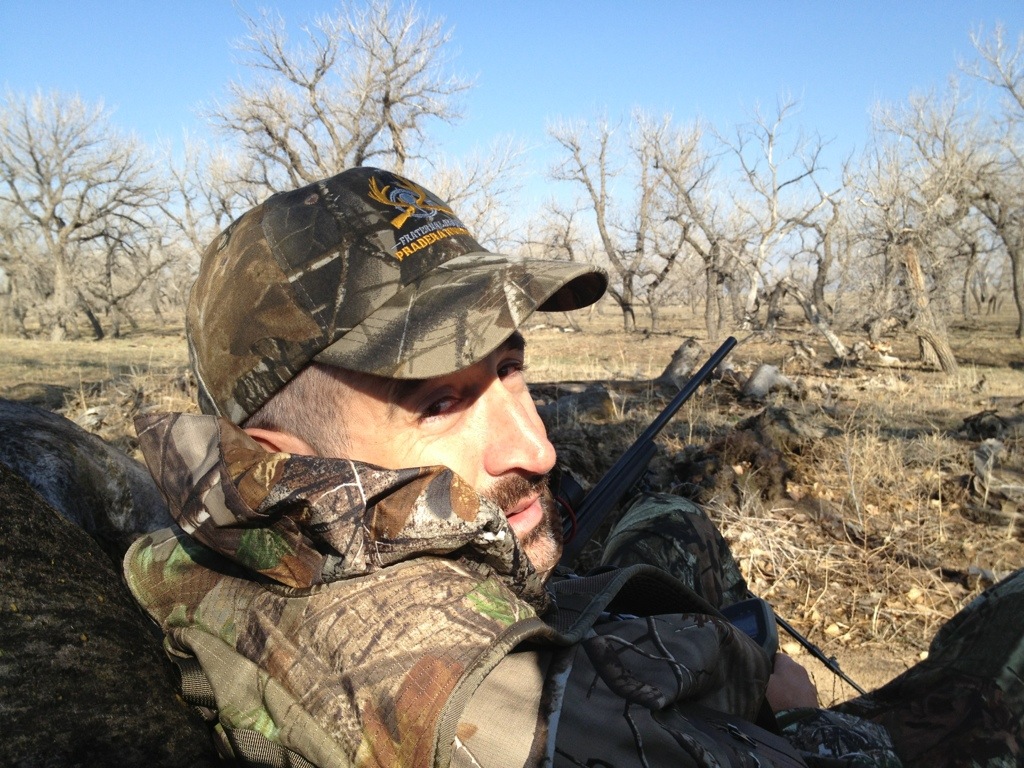
Four thirty am arrived quickly, and the hot pot of Folgers tasted pretty good. We downed a couple of MET-Rx bars, and made our way north to the creek. The sun was rising, the air was warm and we were armed with our Beretta shotguns loaded with HEVI-Shot Magnum Blend shells. We hoped that we could intercept the turkeys as they moved from the trees to the ground. Bob and I took cover in a group of trees just off the edge of the arid river bed. We sat back to back in order to provide a 360 degree view of the territory.

We glassed and called for over an hour, but soon realized that turkeys were not present. While there was some obvious disappointment we decided to change strategies and attempt a predator hunt. I had recently invested in a FOXPRO Wildfire II, and it was a perfect time to see if the electronic call worked. We mounted the speaker on a branch about 50 yards from our blind. I selected the Lighting Jack sound while cranking up the call’s volume to twenty. It did not take but a few minutes before a big yote appeared on the berm about 150 yards east of our position. My Howa Hogue Heavybarrel 1500 .223 was unloaded and propped up on its bipod to my left. I muted the call and reached for the rifle with the ammunition in my right hand. The coyote was running at us at a high rate of speed so my movements were measured. As I raised the rifle to stare down the scope, the coyote appeared 25 yards from our position. Fearing that he would bust us, I used my left hand to activate the Fox Pro. The coyote immediately turned to his right, and started to move toward the call. I chambered a round and took aim. My movement caused the coyote to suddenly change directions, and actually run towards Bob and me. Twenty five yards turned to 10 in a matter of seconds. At that range, the coyote spotted us, and began to cascade away from our position. My first shot missed high; the next two were not even close. Realizing that my marksmanship was less than stellar, I apologized to Bob for the obvious choke-job. We set up in a few more places, but had no success. As mid-morning approached, I thanked Bob for hosting me at the ranch, and headed back to the office.

Next year I plan to take time off work and dedicate a few additional days to preparing for my turkey hunt.

20130615-222425.jpg

Wyoming on the Fly

There are very few opportunities to completely disengage from the day to day grind of life. Living in a wireless world allows for convenient connecting from almost anywhere at any time. Hyper-multitasking is now a requirement if you want to survive in an ultracompetitive business climate. Unfortunately, there are times when emails, voice mails and text messages become unwelcome distractions. When this feeling arises, it is time for me to fish.

Over the last five years, the end of March seems to signal my personal breaking point. The desire to escape in to a river has become a necessity if sanity is to remain a life objective. Since moving west in 2009, I make an annual journey to the North Platte River in Wyoming in order to maintain my equilibrium. The weather is always unpredictable, but the fish are big and aggressive.

Weeks before departing, I begin a ritual of unnecessary acquisitions in order to effectively prepare for the adventure. I make triplicate tackle purchases because there is a profound fear of being without the key equipment at the wrong time. While I consciously realize that most of the money I spend is unnecessary, I cannot seem to stop clicking “PayPal” after nightly “fly fishing” web searches.

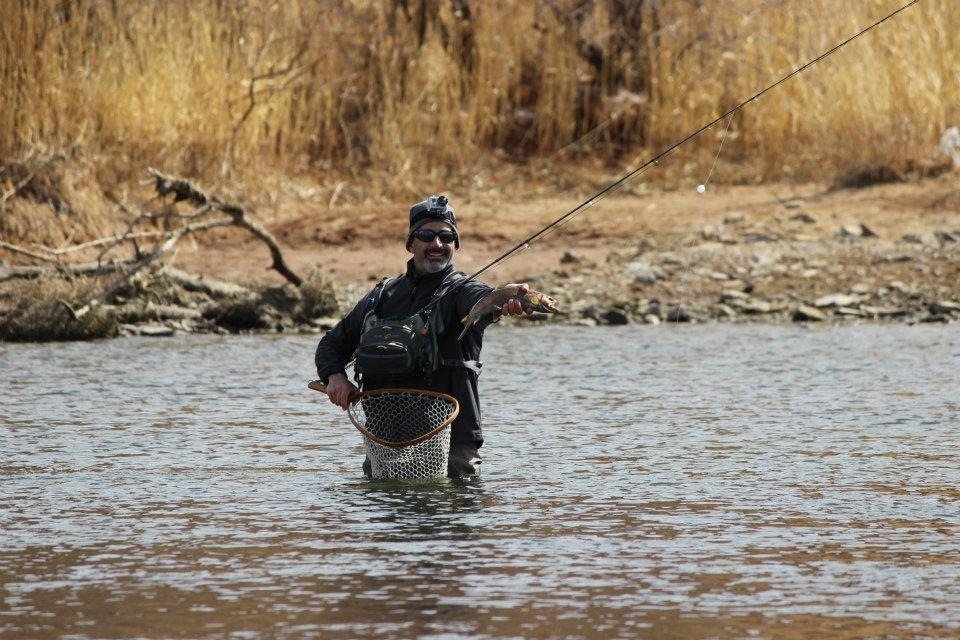
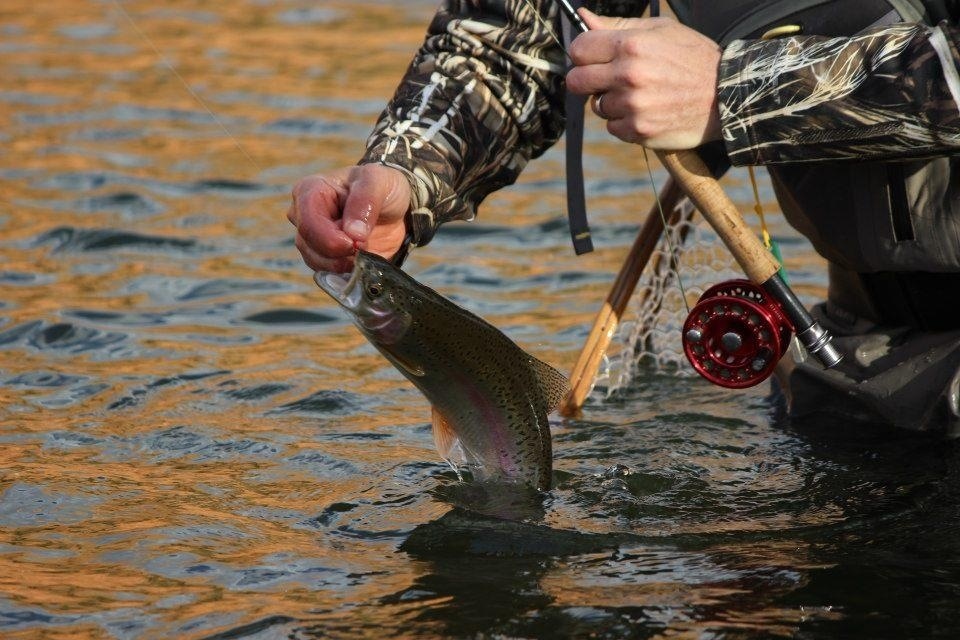
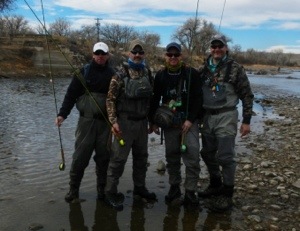
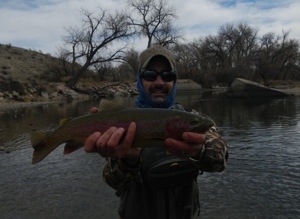
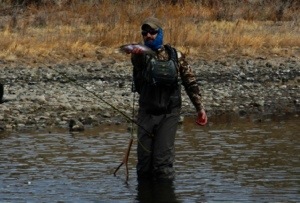
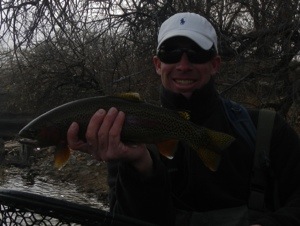
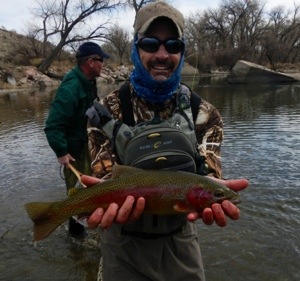
The five hour drive to the river feels as though we have been teleported to Wyoming from Colorado. All available fishing reports exclaimed how prolific the action had been. We arrived just after lunch on March 26th, and quickly scrambled to get our equipment prepared for an afternoon of stalking native rainbows. After some preliminary scouting, we positioned ourselves in the tailwaters closest to the dam. Our research indicated that the fish were feeding on ample food churned up by the nightly flushes. To that point, my nymphing rig contained a purple San Juan worm as the lead fly, and a red rock worm as the trailing bait. The water was 40 degrees cold, but the air temperature was in the high 50s. A warm spring sun became visible as soon as we entered the water. This allowed us to more easily locate fish in the three to four feet of quickly moving water. Chad was the first to hook up, then Bud followed by me. The action was consistent, with 17” to 19” fish caught every fifth or sixth drift. The bows are stout in the Platte, and their strength is really felt with every inch of growth. As the sun disappeared over the horizon, a chilly 15 mph wind became more noticeable, so we ended a successful first day.

Unlike prior years, both AT&T and Verizon wireless signals were non-existent in our area, so our ability to communicate was severely marginalized. This was a unique “issue” that I actually embraced. Instead of checking voice messages, and executing web searches, we spent time talking about the events of the day over dinner. Sleeping is not an issue after a day spent on the river. A pleasant exhaustion sets in quickly after a big meal and a scotch or two.

However infrequent, when fishing becomes my sole focus, my brain becomes enveloped in the task at hand. Every movement has a purpose, and is executed with an underlying strategy in mind. While I maintain a heightened intensity, there is not the accompanied stress. I begin to appreciate the moment rather than constantly reliving the past. Mistakes are made, but do not define the gratification associated with my quest. Happiness is not derived from a monetary gain or retail purchase. Instead, my satisfaction arises from hooking and then landing a fish that I deceived.

On the third day, my friend Paul and I were fortunate to team with a great guide on a float trip down the Platte. Slade Fedore is a Wyoming native, and a master of the waters where he grew up fishing. He comes across confident, but not cocky. It does not take long to realize that he derives his satisfaction in his client’s success. To that point, he worked hard to put us on a lot of fish. Paul and I must have had twenty five double hook ups throughout the day. We were also able to witness a heard of antelope scurry from river’s edge, a bald eagle evade an angry seagull and sand hill cranes battling geese for their spot on an isolated island. We even passed two late season hunters working their GSPs on an evasive pheasant. One hundred and fifty fish later, our right arms told us to pack up and head back to town. It was a perfect Wyoming weather day so we grabbed a few Budweiser’s and a cigar. Sitting outside our cabin, we reminisced about what unfolded just hours before. Make no mistake; I will fish with Slade Fedore again.

The rivers started to fill up with anglers on Friday. The Reef attracts people from around the world, and the spring represents a great time of the year to fish. Even with a bit more pressure, plenty of big trout regularly hammered pegged eggs and rock worms. The morning produced larger fish, while the afternoon seemed to yield an infinite number of strikes.

Saturday morning was a bit somber as it meant the last morning of the trip. Inclement weather has started to move into the area, and it became cold quickly. Even so, I got up early in order to attempt to tie into a cagy North Platte monster. While I absolutely caught my share of 19” fish, the 25” bow evaded my concerted efforts.

Every spring I will travel to Wyoming in order to conduct personal therapy in the North Platte. It is cheaper than a psychiatrist, and the pictures are better. This trip is not about fishing; it is revitalization of my soul. I value every second on the water, and begin to dream about coming back as I depart.

Equipment Utilized

Comments

William Joseph Confluence Pack

Awesome pack. All critical equipment is easily accessible.

William Joseph Conduit Bag

Fantastic bag that you can pack all of your tackle in (even reels).

William Joseph Odyssey Travel Bag

Plenty of room for weeks of travel.

William Joseph Drynamic Waders

Very comfortable, accessible pockets and at a great price.

William Joseph Runoff Jacket

Perfect on a perfect day….not warm enough when the sun is not out.

Under Armour Cold Gear Compression (top & bottom)

Would not fish in the fall, winter or spring without them.

Under Armour Hitch Heavy Boot Socks

Toes were chilly in the 40 degree water, but I never had to exit the river.

Orvis River Guard Easy-On Brogue Wader Boots

Perfect wader boot. Easy on and off. Grips tightly to slippery rocks.

Simms Windstopper Hat

Windstopper technology helps, but I need a warmer lid next year.

Elkhorn T2 Reel

Have not had an issue in four years.

Brodin Ghost Series Frying Pan Net

Expensive but really nice – secure it well as you don’t want to lose it.

Orvis Mirage Fluorocarbon Tippet (3x)

Stayed strong throughout the entire trip – not one break off.

Maui Jim Seawall Sunglasses

Polarized with spring hinges for my big head – perfect.

Wyoming Fly Fishing Guide Service

HIGHLY recommend Slade Fedore (wyotroutbum@hotmail.com)

GoPro Hero2 – Click on the links

http://youtu.be/pCUfmC8tH3k http://youtu.be/C3F_q2pgucI


20130409-213544.jpg

20130409-213607.jpg

Enhanced by Zemanta

25 to the Net

My friend Mike gave me a call early in the week, and asked me to fish with him on Sunday. The President’s Day holiday meant that my son’s sports would end on Saturday, so Sunday was wide open. Given both of our evening commitments, the options were limited to ninety minutes from home base. That means The South Platte River near Deckers, and The Arkansas, are the closest bodies of water that can be accessed. I had not fished since early fall, so I was excited at the opportunity to unwind in a river. Winter fly fishing in Colorado tail waters is special. The opportunity to hook up in February is such a unique experience for a native New Englander. A twelve month season allows anglers to escape at their convenience. If you can withstand the variable weather conditions, there are big fish to be had.

I don’t need an alarm when hunting or fishing is the activity of the upcoming day. To that point, I jumped out of bed at 5 am to prepare to pursue native rainbows. Mike, Luke, Tim and I arrived at the river at about 7:45 am. There were a few other vehicles in the parking lot, but those fishermen had taken a route away from our favorite holes. All of our rods were already rigged, so once the waders and jackets were on, we hurried to the prime spots. During my ten minute dash, I spotted a bald eagle at the very top of a tree; we were both searching for the same quarry.

I picked a section of the river where I have had past success. The fish gather at the end of a thirty foot long shallow riffle that drops quickly into four feet of water moving at 55 CFS (Cubic Feet Per Second). Sporadic cloud cover prohibited me from seeing fish, but I knew the rainbows would be moving into the area as the day warmed. My flies of choice were a #18 flashback pheasant tail on top with a Mike Duerr #20 Yong’s Special as the trailing bait. I tie the flies together with Orvis Mirage Fluorocarbon 5x tippet and use a single Dinsmores BB to get to the required depth.

Trees line the shoreline, so lengthy roll casts are the only safe way to reach my intended targets. Ten drifts did not result in a strike, so I changed positions as well as increased the space between my Thingamabobber and the pheasant tail. As the rig reached the end of its drift, the line stopped and I set the hook. The fished moved quickly up the water column, and spit the hook. Disappointed, I restarted the process to see if I could entice another hit. My friends moved into the spot, and positioned themselves around the large pool. As the first bug hatch of the morning unfolded, everyone began to hook up. Disappointedly, I struggled to keep the larger fish on once the fight began. One big bow actually broke me off at the leader. Once I composed myself, I changed patterns. My Yong’s Special was still my trailer fly, but I put a tangerine soft milk egg on top. Eventually, I started to get in a groove, and my confidence improved as fish were brought to the net.

It was pretty cool to see my neighbor, Luke, take his first fish on a fly. He was a natural nympher, hooking up many times throughout the day. Fly fishing is not an easy sport; technique is almost as important as experience. Luke has neither, yet his production was that of a wily veteran. His success was lauded by the group.

As 2 pm approached, Mike and Tim suggested that we make our way home. I gave the final “last cast” call and flipped my flies upstream. After an initial mend, I achieved the appropriate float. As my indicator neared the end of the run, it went under with force. I raised my right wrist to set the hook, and the fish screamed down river. A ten minute fight ensued, and concluded when a kind stranger netted the brightly colored male trout. He congratulated me for catching “the largest fish” he had seen taken from the river, and we released the rainbow back to the pool.

On our way back to Parker, we stopped to have a couple of beers and reminisce about our success. A warm February day on the water is time well spent.


Equipment Employed

20130223-172856.jpg

20130223-172906.jpg

20130223-172920.jpg

20130223-172930.jpg

20130223-172943.jpg

My 2012-2013 Season Ends

My last hunting trip of the 2012-2013 pheasant season started out like any other journey to Eastern, Colorado; up at 4:00 am, out the door by 4:50 am and adjacent to my favorite field by 7:45 am. The temperature was sixteen degrees, and there was a subtle ten mph wind easing its way in from the northwest. The conditions were great, but I felt I was about forty five minutes behind schedule. My gut told me that the birds had already made their way into the corn fields where they could not be pursued. Pride and I quickly worked our way through the shin high CRP. I knew that if there were birds to be had, they would be holding tight in the deeper cover along the draw at the end of the field. Pride has often sought our quarry in this field, and he knows when to turn on his afterburners. Not dissimilar to our last trip, we moved quickly through the one hundred and fifty yards of brush but never encountered a bird. It was the second trip in a row that my honey hole failed to produce results.

The night before the trip, I phoned a rancher friend who had allowed Pride and me to hunt his land on three occasions during the season. For over two seasons, I never received a positive answer to my question “would it be possible to walk your land with my dog”. Honestly, I developed a complex as landowners repeatedly denied my requests to access their property. Unfortunately, my appeal to make a final tour of his prime real estate was denied. He emphasized the need to end the season early in order to give the birds a “break”. Nevertheless, I stopped by the house to drop off a case of bud light, and a personal thank you card addressed to the family.

Pride and I headed one half mile east then unloaded next to a large grass field that abutted corn. The snow that blanketed this field three weeks before was almost gone, and had unfortunately matted down the already sparse cover. We employed a zigzag pattern in order to cover ground, and perhaps confuse a running rooster. Pride did get hot as we marched towards the end of the field. When he slowed down and began to sniff in circles, I prepared myself for action. It took about thirty seconds, but a hen jumped up thirty yards in front of me. A few “no bird” calls had Pride ready to continue our walk west. Thirty minutes later we loaded up, and maneuvered to another favorite area about four miles southeast of our position. When I arrived at the field, there were already three trucks surrounding the area so I moved on. Pride and I spent the next hour covering an enormous field that did not show any signs of life. Disappointed but undeterred, we headed to town to fill up the Dodge Ram 1500, and get some food.

With a Monster Rehab energy drink and some jerky in hand, I stared at the map to determine our next move. Another hunter pulled into the market so I asked him how his day was going. He described an all too familiar story; working two dogs, he was able to get some birds in the air, but not close enough to attempt a shot. I asked him if he would like to hunt together to see if we could improve our odds. He responded with enthusiastic “yes”, so we began to collaborate on an afternoon strategy.

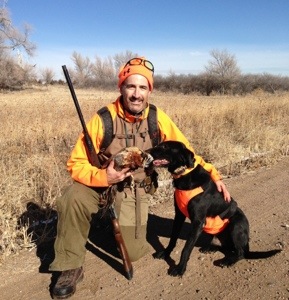
With a renewed focus, we drove further east towards some pivots that we hoped had not been mowed down. About five miles into the drive, Tom slowed and waived me up. He had noticed a one hundred yard row of evergreens in a walk in area just off the adjacent road. The plan was simple; I would drive to the east and work Pride west, and he would counter that with his two Brittany spaniels. I quickly made my way west, weaving between the fifteen foot evergreens. As Pride neared Gunner and Major, all dogs simultaneously turned quickly in the direction of the road. A rooster busted from the tree line, and flew straight back to the east. The tip of one tree prohibited me from executing an immediate shot, so I jumped forward and reset my position. My first shot from my Beretta A400 XPLR Light 12 gauge missed high, but the next shot knocked the bird down immediately. Pride ran furiously at the mortally wounded pheasant, and brought him to my hand. We thanked the dogs for their efforts, exchanged congratulations, and then continued on our way. The excitement level had suddenly intensified for all participants.

The next four pivots we hunted appeared amazing, but produced nothing. We hunted every inch of the dense CRP, hoping to move birds into the surrounding corn fields. Unfortunately, two miles of stalking produced only one startled hen. We continued our drive north towards Nebraska with the hope that the extra miles of driving would eventually pay off. We came across a unique walk in area that had knee-high grass surrounding a dense and long plum thicket. Tom, Gunner and Major took the right side of the trees, while Pride and I moved left. About half way through the walk south, Pride became birdy. Nose down and tail vigorously moving, he began to demonstrate signs of a pheasant in our presence. I readied for a shot but nothing happened. Tom and his dogs turned the corner around the plum thicket, and marched southeast. We both acknowledged that our dogs were in pursuit of moving prey, and the pace suddenly quickened. Pride moved to my right, and ran hard to the edge of the field. Tom was positioned about fifty yards to my right, and we expected the dogs were on a crafty cock bird. When Pride started to forcefully dig his nose in a clump of grass, a rooster jumped just inches from his head. As the bird took flight, all three dogs started their chase. The bird flew low which caused me to delay a shot as Major was in my field of vision. Tom, however, had a clear shot and knocked the bird out of the sky with his Winchester SX3 20 gauge.

It was now 4 pm, and we needed to quickly make our way to our last field of the day. The land that I had in mind always has birds moving from corn to cover as night approaches. As we drove up to the edge of the CRP, birds were already taking flight. We quickly piled out of the trucks, and jumped into the tall grass. The dogs were moving with determination as they obviously knew pheasants were sprinting away from us. After five hundred yards we turned back toward the west with the hope that some of the birds that we passed would hold tight. Unfortunately, these late season pheasants have been conditioned to outwit their pursuers. As the sun set, we watched the running birds take flight against the red sky. While we were disappointed that a shot never presented itself, the scene that unfolded in front of us was pretty awesome.

My 2012-2013 pheasant season appeared bleak at the outset. The drought that has savaged Colorado over the last 12 months was clearly visible to the not so discerning eye. Farmers, ranchers and landowners were all suffering, and so were the birds that depend on the habitat to survive. Hopefully, significant precipitation hits the region soon, and solves what is becoming an ever worsening problem. While the number of birds I harvested was far less than last year, I still had an amazing time. November cannot come soon enough.

Equipment Used in the Field

Shotgun

Beretta A400 XPLR Light 12 gauge, modified Trulock choke

I love this semiautomatic. I have a couple of fancy O/U’s, but they sit in the safe for a reason. This gun is light and reliable. I have had only two jams in three years. Unfortunately, it came in the midst of two amazing flushes. Cleaning the weapon is intimidating, but can be accomplished. This is will be my upland shotgun for a very long time.

Pack

Badlands’ Birdvest

Badlands is known for their big game packs and clothing. That said their upland pack is awesome. My favorite components are the two magnetic shell holders that sit on either side of the waist buckle. When it is cold, and you are scrambling to reload, these pouches provide quick access to the necessary ammunition. Badlands must redesign the elastic shell holder as twelve gauge shells fall out easily. I would also recommend deeper external webbing.

Jacket

Cabela’s Activ-Lite Upland Jacket

Comfortable jacket that can be used as a top layer on colder days. The jacket blocks the wind, while maintaining a loose fit.

Base Layer

Nike Pro Combat

I like wearing this product from Nike. The material really wicks away moisture and keeps you warm.

Boots

Irish Setter King Toe DSS 820

My best buy in 2011. These boots are comfortable, and can be worn in temperatures in the low single digits. I put a ton of miles on these boots and never suffered a blister or an injured foot.

Socks

Smartwool

These socks are so comfortable that I purchased 5 pair. My feet stay dry and warm.

Sunglasses

Oakley Scalpel

I am not an Oakley guy, but these are great shades. When it is bright or I am fishing, I wear the dark polarized lenses. When there is little sunlight, I put in the yellow lenses. Oakley’s are expensive, but my Scalpels have been a worthwhile investment.

Truck

Dodge Ram 1500 (2011)

The truck has operated flawlessly over the last 15 months. I did destroy two of my Goodyear tires, and had to make an unexpected investment in four new Hancook tires.

Gloves

Under Armour

Work very well when the temperature drops. I often debate putting them on as I want to maintain the proper feel of my shotgun.

Hat

Under Armour

I own five of these hats. Unfortunately, they get misshapen quickly and do not last. Sort of disappointing.

Camera

GoPro Hero 2

Of course I never had the camera on when I found birds. When it is turned on, the quality is great.

Dog (Pride)

Bred and trained by Gary Ruppel (Kiowa Creek Kennels)

Gary is the best in the business. He is a straightforward, kind and honest man. He also breeds/trains great dogs. What more could you want?


20130125-214928.jpg

Enhanced by Zemanta

Not a Chance

Late December brought on another cold. I had just recovered from a nasty flu bug, only to wake up on Christmas morning with many of the same symptoms that occurred earlier in the month. My condition was very disappointing as I planned on taking Thursday and Friday off for bird hunting in Eastern Colorado. Lots of water, plenty of Cold Eeze and a couple of DayQuil provided me the elixir for ensuring I would spend time in the field.

Despite the constant coughing, and leaky nose, I awakened at four am on December 28th to leave for the two day trip. The Dodge Ram 1500 was already packed, and sported four new Hancook DynaPro tires. On my last two trips, I tore up two of the Goodyears that came with the truck. The Hancooks were an unexpected and untimely investment made at Discount Tire. Greg met me in front of my house at five am with his truck as he planned on coming home that evening.

The two and three quarter hour drive had us entering bird country with five inches of fresh snow on the ground. The conditions were perfect; a five degree air temperature and a light westerly wind had Greg, Pride and me set up for pheasant hunting success. Driving down the first country road, we spotted thirty birds dancing through the unharvested corn. Two miles later, we entered my favorite field with the sole purpose to make it to the thickest cover situated one thousand yards from our trucks. We worked the edge of the CRP until we reached the berm where I hoped birds were holding tight. Pride is familiar with this land, and he worked feverishly to find a fresh scent. The deep snow drifts made moving to the key area slow and tiring. The effects of my cold were obvious as I struggled to catch my breath during the deliberate jog. Pride was obviously excited as he darted into the tumbleweeds. His speed allowed him to cover a lot of ground, and he looked in every nook that could possibly hold birds. Greg and I made our way west along both sides of the draw waiting for a rooster to take flight. It did not happen. In fact, the entire field did not produce anything of merit.

Although we were a bit disappointed, we knew that there were birds to be had if we hunted the right fields. Greg and I drove to some popular public spots where we encountered hunters who were already in pursuit. We drove slowly along the adjacent private land, and we witnessed more than fifty pheasants moving from the tree line to the corn fields. The temptation to pull over and hunt this area was real, but inappropriate, so we moved on.

Due to the lack of cover, the options were limited, so we decided to venture to the private land where we have permission to hunt. The rancher had planted two rows of evergreens that were situated just to the north of his house. Given the conditions, I felt there should be birds present as they would be seeking protection from the elements. Instead of entering the area from both sides, we decided to walk together from the east. Despite our stealth approach, the birds started to fly into the adjacent CRP before we closed the truck’s doors. We sprinted into the tree line only to see more birds jump too far away to get off a shot.

All of the pheasants that flew from the trees touched down in the rancher’s CRP just south of our position. The strategy became obvious; Greg would move southwest and I would take Pride five hundred yards to the south and hunt him into the wind. If we worked the area correctly, perhaps we could force the evasive roosters into the air. One thing that was clearly evident in this field, was that there were the fresh tracks of pheasants everywhere. There was no doubt that Pride smelled bird, as his head remained low and his tail moved swiftly from side to side. As we walked towards Greg, I anticipated we would see exploding birds. Disappointingly, it never happened. We hunted the rest of the field over the next forty five minutes, and never got a bird to fly. On a hunch, I told Greg we should once again hunt the tree line, as I saw two birds fly back into the cover minutes after we departed. This time, I dropped Greg off on the eastern side and I quietly made my way west. We moved in unison, trying to pinch the birds and force them into the air. I readied myself when I saw a hen sprint from a bush to the trees. Another hen surprised me when she took flight, and then another soon followed. A rooster flew straight up then banked a hard right towards Greg. I yelled “rooster” and heard Greg take a single shot from his Beretta Silver Pigeon. Two more hens darted from their hiding places, and flew less than twenty feet from my barrel. When I realized all of the birds had left the area, I made my way to Greg with the hope that he would have a downed rooster in his hand. Unfortunately, his shot had not found it’s mark, and we were still without the intended quarry.

We hunted for another two and a half hours before realizing that the sun was setting quickly. My rancher friend told me the name of the landowner who abutted his property. I called him with the hope that he would grant us permission to walk his fields. When I got him on the telephone, I introduced myself, and asked him the critical question. He responded with a resounding “no”. Disappointed, we drove from country road to country road trying to locate cover that we could hunt. After an exhausting and disappointing forty five minute walk through a WIA stacked with evergreens, we made our way back to the rancher’s land for one last effort before dark.

Greg and I walked the initial 100 yards into the CRP, and startled two hens that had hunkered down for the night.

Unfortunately, my cough became more intense and constricting as the day concluded. To that point, I made a decision that staying the night would not be prudent, so I made my way back home.

Ideal weather conditions do not always mean that an opportunity to shoot a bird will present itself. We were diligent in our effort, but luck was not on our side. Despite our lack of success, we encountered many birds that we will pursue aggressively at a later date.

Enhanced by Zemanta

Working Hard so I can Hunt, Fish and Golf